Straight Answers on Spray Foam Insulation for Greater Cleveland
Common questions about spray foam insulation across Greater Cleveland, from safety and cost to what our winters do to a house. The answers below cover the questions we hear before a project starts; for the deep, service-specific ones, every service page on Cleveland Spray Foam Company carries its own detailed FAQ section.
Getting Started With Spray Foam in Cleveland

We walk the building with you, look at the spaces in question, and check the places Cleveland homes predictably leak, from the attic plane down to the rim joist. Then you get a firm written number, an explanation of exactly what we’d do and why, and honest answers to anything we find, including the occasional “fix this other thing first.” There’s no fee, no obligation, and no pressure; the estimate is information, and it’s yours either way.
Not at all, and most people don’t. Symptoms are plenty: a cold room, an ice dam, a musty smell, a bill that keeps climbing. Part of our job is translating what you’re feeling into what the house is doing, and our air sealing page exists precisely for the “everything feels wrong and I don’t know why” situation. Call with the symptom; we’ll bring the vocabulary.
Yes, and in Cleveland it’s a busy season for good reason: winter is when houses confess. Professional spray equipment conditions the material for cold-weather work, and interior surfaces like attics, basements, and rim joists install fine year-round. If a specific surface or cold snap calls for adjusting the schedule, we’ll tell you at the estimate, but nobody needs to wait for June to fix a January problem.
Smaller jobs like a rim joist are usually a single day. Attics generally run one to two days depending on size and whether old material comes out first. Crawl space encapsulations and whole-house projects vary more, and your estimate includes a real schedule for your actual scope. Most homeowners are surprised how quick the work is; the results last decades, but the disruption is measured in days.
Safety, Materials, and Living With Foam

Yes. Once cured, spray foam is inert and stable, and it’s installed under codes written specifically for it, including required coverings between foam and living space. The precautions all belong to installation day: the work area is contained and ventilated, and re-entry follows the manufacturer’s cure window. Millions of homes live over, under, and behind this material; the safety story is about professional installation, and that’s exactly what you’re hiring.
During installation there’s a noticeable odor in the work area, which is why we ventilate and keep the household out of the immediate space until the foam cures, typically about a day. After curing, properly installed foam is odorless. The horror stories you may have read trace back to badly mixed, off-ratio foam from rushed or DIY installs, and preventing that is a matter of equipment, training, and patience, three things a professional rig exists to provide.
Foam is combustible, like the lumber, paper-faced drywall, and everything else your house is framed with, and building code treats it accordingly: foam in living spaces gets covered with a thermal barrier such as drywall, and foam in attics and crawl spaces gets the protection code specifies for those areas. We build that protection into every spec. Installed to code, foam doesn’t add fire risk, and by sealing the open air channels in older homes, it removes one of the ways fire historically traveled.
For practical purposes, the life of the building. Foam doesn’t sag, settle, absorb water, or slide out of position, which are the ways traditional insulation dies, usually within 15 to 25 years. Once it’s in, it’s in: no fluffing, no topping up, no replacement cycle. It’s one of the few home upgrades you genuinely buy once.
Cost, Value, and What Cleveland Gets Back

Because it’s doing more jobs. Fiberglass slows heat; foam slows heat while sealing the air leaks and blocking the moisture that ruin fiberglass in this climate. You’re comparing a material that needs replacing every couple of decades and does one job to a material that lasts the life of the house and does three. In a heating-dominated, moisture-heavy market like ours, the gap pays itself back through energy savings, and everything after payback is profit.
Four things, mostly: the square footage being treated, the foam depth the assembly needs, which foam the surface calls for, and what has to happen first, like removing old insulation or improving access. That’s why we don’t quote from the phone; two identical-sounding attics can be very different projects. The estimate is free and itemized, so you can see exactly where the number comes from.
Sometimes, and they change often enough that we won’t quote a program here that might be gone by the time you read this. Utility companies serving Northeast Ohio have historically offered efficiency incentives that included insulation and air sealing, and programs come and go at the federal and state level too. Ask at your estimate and we’ll point you to whatever is actually current, rather than what a website promised last year.
No. Every estimate is free, on-site, and results in a firm written number, not a range that doubles later. We’d rather walk a building and earn the job with a real answer than win it with a lowball guess, and the estimate costs you nothing but the walk-through.
Cleveland's Climate and Cleveland's Houses

Geography, mostly. Lake Erie keeps our humidity elevated in every season, our transitional months cross the freezing point several times a week, and every crossing pushes moisture deeper into walls, foundations, and attics. Add air leaks that carry humid indoor air into cold assemblies where it condenses, and you get our region’s signature pattern: insulation failures that are really moisture failures. It’s the single idea our whole company is built around, and it’s why we treat sealing and insulation as one job.
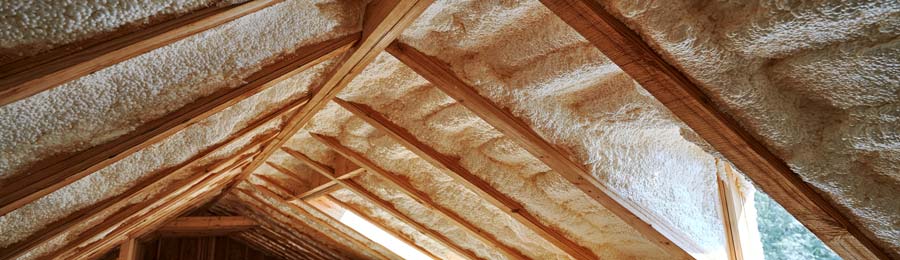
The honest answer is the one that controls air and moisture, not just temperature, because around here those are what kill insulation. Spray foam is the only common material that does all three, and the craft is in using both types correctly: closed-cell where moisture pressure lives, open-cell where deep cavities need filling. Any material can hit an R-number in a catalog. Surviving a Cleveland freeze-thaw spring is the real test.
In most cases, yes, and it’s some of our favorite work. Old homes offer access points their builders never thought of as access points: the attic, the basement, the rim joist, knee walls, and the open tops and bottoms of wall cavities. Sealing from those positions transforms how a century home performs while the plaster stays exactly where it is. When a wall does need opening, it’s the exception, we’ll say so up front, and it’s your call.
Usually the insulation and air sealing are the story, especially in rooms over garages, at the ends of duct runs, or under leaky attics, and the fix is dramatic. But not always, and we’ll tell you when it isn’t: sometimes a cold room is an HVAC balancing problem or a duct issue that foam won’t cure. The assessment sorts that out before you spend anything, which is the point of doing one.
Service Area, Scheduling, and Small Jobs
Cleveland and its surrounding communities, with dedicated coverage of Parma, Lakewood, Euclid, Strongsville, and Mentor. The real boundary is the weather, not the map: if your house deals with lake-effect winters and freeze-thaw springs, you’re probably in our territory. Outside those cities, reach out anyway and we’ll confirm service for your address, which we do all the time.
Small jobs are welcome, and honestly, they’re how many of our best customer relationships start. A rim joist, a bonus room over a garage, a single drippy pole barn roof: these are one-day projects with outsized results, and there’s no minimum grandeur required to call us. Plenty of homeowners start with the small fix, feel the difference through one winter, and plan the next project from there.
Both, and the physics don’t care about the zoning. The same moisture and heat-loss principles that fix a Lakewood century home fix a warehouse roof deck that rains condensation on inventory. Residential, commercial, agricultural, and the pole barn that’s a little of each: if it has a building envelope in Northeast Ohio, we insulate it.
Usually within a few days for an estimate, and we reply to inquiries the same day whenever we can. Like every trade, our calendar breathes with the seasons; the surest way to a fast slot is reaching out when you first notice the problem rather than the week the forecast turns brutal. Either way, tell us what’s going on and we’ll give you a real timeline, not a hopeful one.
Didn’t See Your Question? Ask It on Your Own Doorstep.
The deepest answers we give are the ones specific to your building, and those happen in person. Every estimate is free, covers the whole envelope if you want it to, and comes with plain-English answers about your house, your symptoms, and your options across Cleveland, Parma, Lakewood, Euclid, Strongsville, and Mentor.