Rim Joist Insulation Stops the Cold Creeping In at the Top of Your Foundation
The rim joist is the band of framing your whole house sits on, and in most Cleveland homes it’s bare wood facing a January wind. Two to three inches of closed-cell foam turns the leakiest spot in the basement into the tightest.
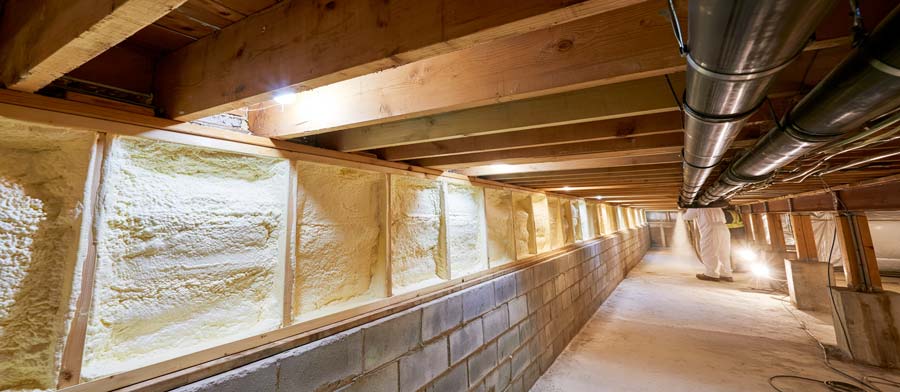
The Most Important Board in the House Nobody Ever Insulated
Cleveland Spray Foam Company asks about the rim joist on nearly every estimate, because it’s the highest-value few inches of framing in the house and almost nobody has touched it. Also called the band joist, it’s the ring of lumber that caps your floor framing where the house sits on the foundation: above the concrete, below the floors, penetrated by gas lines, water lines, dryer vents, and electrical service. It’s the coldest wood in the house, and in most Cleveland basements it’s either bare or stuffed with fiberglass that’s making things worse. Rim joist insulation with closed-cell foam fixes it permanently, usually in a single visit:
- The whole perimeter band gets air-sealed in one pass, closing one of the five worst air-leak points in a Zone 5 home
- R-12 to R-20 lands on the coldest framing you own, from 2 to 3 inches of closed-cell foam
- The vapor barrier forms at 2 inches, ending the condensation that rots rim framing from the inside
- Every utility penetration gets sealed, the gaps around pipes, vents, and wires that leak day and night
- No demolition, because the joist bays are already open and waiting in the basement ceiling
Where the cold actually gets in
A heated house works like a chimney. Warm air exits high, through the attic, and the replacement air gets pulled in low, and the rim joist is the intake. That’s why the drafts show up along baseboards and floor edges two stories away from the actual leak. Seal the intake and the whole chimney slows down: the basement holds heat, the first floor stops feeling drafty at the edges, and the furnace stops reheating outdoor air all winter.
Why fiberglass in the rim bays backfires
Fiberglass doesn’t stop air, it filters it. Warm, moist basement air passes straight through the batt, hits the freezing wood behind it, and condenses. The batt then holds that moisture against the framing, which is why rim-bay fiberglass in Cleveland so often comes out dark, damp, or moldy. Closed-cell foam does the opposite: it stops the air, blocks the vapor, and bonds to the wood so there’s no cold surface left for moisture to find.
Signs Your Rim Joist Needs Sealing
✓ Cold floors along the outside edges of rooms every winter
✓ Drafts near baseboards on the first floor you can’t trace
✓ Frost or condensation on the wood above the foundation wall
✓ Fiberglass in the joist bays that looks dark, damp, or moldy
✓ Pipes near outside walls that freeze or run cold in snaps
✓ A basement that never holds heat no matter the thermostat
A One-Day Job Your House Feels Every Winter After
The rim joist is a small surface with an outsized job. Even a modest Cleveland ranch carries well over a hundred linear feet of it, every foot exposed to outdoor temperatures and stitched with penetrations, and all of it concentrated where the house pulls in its replacement air. That’s why sealing it delivers results that feel out of proportion to the size of the project.
It also stacks. Rim joist foam is the natural companion to basement wall insulation and crawl space work, and when we’re already in the space, adding the band is quick. Plenty of homeowners start with just the rim and come back for the rest after their first winter with it.
Why the payback comes fast
01 A small area carries an outsized share of the whole house’s air leaks
02 One material delivers air seal, vapor barrier, and R-value in a single pass
03 The bays are already open, so there’s nothing to demolish or rebuild
04 Perimeter pipes and ducts stop fighting winter, cutting freeze risk
05 Every floor above feels the difference, not just the basement
Your Rim Joist Insulation Questions Answered
It’s one of the smallest-ticket spray foam projects we do, priced by the linear footage of the band and the depth of foam specified, and we give a firm number after a quick look at the basement. The estimate is free, and because the rim concentrates so much of a home’s air leakage into so little area, this project routinely delivers the fastest payback of anything on our list. It also bundles efficiently: if we’re already insulating basement walls or a crawl space, adding the rim costs less than doing it as a standalone visit.
It’s the band of lumber that runs around the entire perimeter of your floor framing, capping the ends of the joists where the wooden structure of the house sits on the foundation. Builders also call it the band joist. It matters because it’s the transition point between concrete and wood, it faces outdoor air with no living space to buffer it, and it’s where utilities like gas, water, electric, and dryer vents punch through the shell of the house. Cold framing plus a ring of penetrations is why it leaks more than any surface its size.
Two to three inches of closed-cell is the standard spec. The air seal takes effect within the first inch, the vapor barrier forms at about two, and by three inches the band is carrying roughly R-20 on framing that previously had nothing. Going thicker than that buys very little in a rim bay; the value is in the sealing, and two to three inches captures essentially all of it. We spec the exact depth per house at the estimate.
Fiberglass is the one material we’d actively talk you out of, because it lets moist air through to condense on the cold wood and then holds that moisture against the framing. Rigid foam board cut into each bay can work in theory, but every piece must be individually fitted and sealed around joists, wires, and pipes, and in practice those jobs are rarely airtight and take longer than spraying. Closed-cell foam conforms to every irregular bay and penetration on its own, which is why it’s the standard answer for this assembly.
Yes, and usually the first floor too. The basement warms because its largest uncontrolled opening to the outdoors is gone, and the floors above warm at the edges because the cold air that used to wash in under them has been shut off. Homeowners tend to notice it within days, especially in rooms over the band. Pairing the rim with basement wall insulation finishes the job and turns the basement into genuinely conditioned space.
Very likely, because most perimeter pipe freezes are air-leak problems, not temperature problems. A pipe near the rim isn’t just sitting in a cold room; it’s sitting in a stream of subfreezing outdoor air pouring through the band. Sealing the rim shuts off that stream, and pipes that used to be one polar night from bursting sit in still, warmer air instead. It’s not a guarantee for pipes buried in truly unheated spaces, but for the classic Cleveland perimeter freeze, the rim is the first fix we’d make.
In our specs, yes. The rim sits at the top of the crawl space walls, and sealing everything below it while leaving the band leaking would undercut the whole system, so foam on the rim is part of how we build a crawl space encapsulation. If you have both a basement and a crawl space, as many older Cleveland homes do, we treat the rim as one continuous perimeter and seal it end to end.

Get Your FREE Estimate
Tell us about the drafts, the cold floors, or what the joist bays look like. We’ll get back to you the same day whenever we can.