The Closed-Cell Spray Foam Insulation Cleveland Basements Have Been Waiting For
One material that insulates at R-6 to R-7 per inch, seals out air at one inch, and stops moisture at two. In a lake-effect climate, that third job is the one that protects your house.
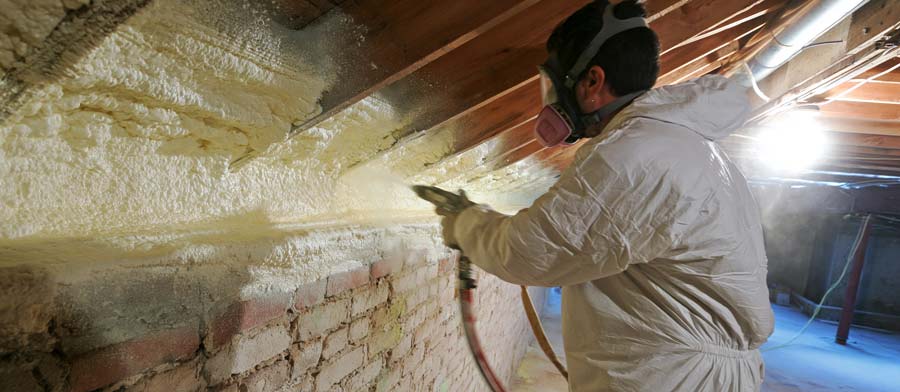
Insulation, Air Barrier, and Vapor Barrier in a Single Application
Cleveland Spray Foam Company puts closed-cell foam where a Cleveland home takes the most moisture pressure: rim joists, crawl space walls, basement walls, and framing cavities too shallow for anything else to reach code. It is the densest foam we install, and in a Zone 5A climate the numbers are the whole argument for it:
- R-6 to R-7 per inch, the highest R-value per inch of any insulation commonly installed in a home
- An air barrier at about one inch, closing the gaps and joints that leak heated air all winter
- A vapor barrier at about two inches, blocking the moisture drive that ruins fiberglass and rots framing
- 2 pounds per cubic foot of rigid density that bonds to wood, brick, and concrete and adds real structural stiffness to the assembly
- FEMA-listed as flood-resistant, so it survives the wet basement events that soak and finish off conventional insulation
Why the vapor barrier matters more here than almost anywhere
Lake Erie keeps Cleveland’s humidity elevated all year, not just in summer, and our transitional seasons cross the freezing point multiple times in a single week. Every one of those swings pushes moisture toward the cold side of your walls and floors. Fiberglass lets that moisture pass through and hold; closed cell spray foam insulation stops it at the surface, which is why it is our default answer anywhere concrete, soil, or outside air sits on the other side of the assembly.
Applied in lifts, about two inches per pass
Closed-cell foam cures with real heat, so it goes on in controlled passes of roughly two inches, each lift bonding to the last. It is slower than flooding a cavity in one go, and that is the point. Correct lift thickness is what produces foam that cures at full density and full R-value instead of foam that merely fills space. It is one of the clearest differences between a professional installation and a rushed one.
Signs Your Home Is Ready for Closed-Cell
✓ Cold air pouring through the rim joist band above your foundation
✓ A crawl space that smells damp from spring thaw through fall
✓ Frost, condensation, or peeling paint on basement walls each winter
✓ 2×4 walls too shallow for fiberglass to ever reach code
✓ A garage or metal outbuilding that drips condensation inside
✓ Musty odors that return no matter how often you run the dehumidifier
Built for a Climate That Crosses Freezing Twice a Week
Cleveland’s freeze-thaw cycling is relentless in spring and fall, and every crossing works moisture deeper into foundations, band joists, and wall assemblies. Insulation that absorbs water in this climate is on a countdown from the day it goes in. Closed-cell foam does not absorb water, does not sag away from the framing, and does not give moisture a path into the cavity behind it.
That is why we treat closed-cell as a moisture-control decision first and an R-value decision second. Where your home meets concrete, soil, or lake air, it is usually the only material we will recommend.
Where closed-cell earns its keep
01 Rim joists, where 2 to 3 inches is one of the highest-ROI upgrades in the whole house
02 Crawl space walls that need insulation and a vapor barrier in one material
03 Basement walls, bonding directly to concrete with no fasteners or framing required
04 Shallow exterior walls that have to reach code performance in 3.5 inches
05 Pole barns and metal buildings that sweat through every Ohio winter
Your Closed-Cell Spray Foam Questions Answered
Closed-cell is priced by the board foot, and it costs more per inch than open-cell because it is denser and does three jobs at once: insulation, air barrier, and vapor barrier. The final number depends on the square footage, the depth required, and how much prep the space needs, so we give a firm price after seeing the area rather than a guess over the phone. The estimate is always free, and because closed-cell targets the leakiest parts of the house, it tends to pay itself back faster than its price per inch suggests.
Closed-cell is rigid, dense foam at R-6 to R-7 per inch that becomes a vapor barrier at about two inches. Open-cell is soft, light foam at R-3.5 to R-3.8 per inch that seals air movement but stays vapor-permeable, which makes it better suited to deep wall cavities and sound control. In broad terms, closed-cell wins wherever moisture is part of the problem, and open-cell spray foam insulation wins where you have depth to fill and want quiet, comfortable interior rooms. Many Cleveland projects use both, each where it belongs.
It depends on the job the foam is doing. Air sealing takes effect at about one inch, the vapor barrier forms at about two inches, and rim joists are typically sprayed at two to three inches. Basement and crawl space walls usually land in the two to three inch range to meet Zone 5 code values, while shallow exterior walls may take three inches or more to hit their performance target. We spec the depth for each surface during the estimate so you are paying for exactly the performance the assembly needs.
Honest answer: it costs more per inch than any other common insulation, it is a permanent installation that bonds to the structure, and it demands a disciplined installer because it must go on in controlled lifts of about two inches to cure properly. It is also not the right tool everywhere; deep cavities that need vapor permeability are often better served by open-cell. Where it belongs, though, none of those downsides outweigh getting insulation, air sealing, and moisture control from a single material.
Closed-cell foam is not a food source and its density makes it an unattractive material for rodents to work through, especially compared to fiberglass, which mice treat as ready-made nesting. Just as important, foam seals the gaps and penetrations pests use to get in at the rim joist and foundation line in the first place. It is not a pesticide and a determined animal can chew almost anything, but closed-cell removes both the easy entry points and the cozy bedding that attract them.
Yes, and it is one of the few insulation materials that is. Closed-cell foam is listed by FEMA as a flood-resistant material because it does not absorb water and keeps its structure and R-value after getting wet. It also bonds directly to concrete and block without fasteners, so there is no framing cavity to trap moisture behind it. Bulk water problems still need to be fixed first, but once they are, closed-cell is the insulation built to live next to a Cuyahoga County foundation.
Kits exist and can handle a very small patch, but closed-cell is unforgiving of temperature and mixing errors. Professional closed cell spray foam insulation contractors run heated, pressure-balanced rigs that keep the two chemical components in exact ratio; off-ratio foam can cure soft, shrink, or hold a persistent odor, and the only fix is cutting it out. Kits also cost far more per board foot than a professional job once you get past a few square feet. For anything larger than a single small repair, the rig wins on both quality and price.

Get Your FREE Estimate
Tell us where the cold or the damp is getting in, or just describe what you’re seeing. We’ll get back to you the same day whenever we can.